In the context of environmental health, vulnerable populations include various groups that are more likely than the general population to experience adverse health effects following exposure to environmental contaminants. This vulnerability can be characterized by two types of factors: (a) intrinsic factors that usually cannot be altered, such as age, pregnancy, gender, ethnicity, and genetic polymorphisms, and (b) extrinsic factors that usually can be altered, such as socioeconomic status (SES), health status, eating habits, lifestyle, and geographic proximity to sources of exposure.
The main population groups affected by intrinsic factors are fetuses, infants, children, pregnant women, the elderly, and people with a specific genetic polymorphism or a chronic illness such as cardiac or pulmonary disease. Population groups affected by extrinsic factors include people of low SES, who generally have higher smoking rates, less access to high quality healthcare services, and work conditions that are hazardous to health; people with poor nutrition; people who live near sources of exposure to potential contaminants such as agricultural fields, heavy industry, contaminated sites or highways; workers in chemical-intensive industries and people who do not reside in permanent structures.
Environmental health policy in Israel aims to protect vulnerable populations and takes them into account when setting standards for air, drinking water, and food. Furthermore, in cases of severe air pollution, the Ministry of Environmental Protection (MoEP) and Ministry of Health (MoH) issue advisories and recommendations for the general public as well as specific recommendations for vulnerable populations. Many mandatory consumer product standards in Israel target products intended for infants and children, including toys, baby bottles, beds, mattresses, eating utensils, and children’s jewelry.
Progress relevant to vulnerable populations has been achieved in many areas of environmental health in Israel. Standards that limit heavy metal content in children’s jewelry and lead in paint, including paint used for playground equipment, have been approved as mandatory. Biomonitoring research pertinent to vulnerable populations, such as children and pregnant women, has seen significant progress. (See the “Human Biomonitoring” and “Chemicals in Consumer Products” chapters.) A survey on lead and other heavy metals in tap water in educational institutions throughout Israel was conducted in 2018. (See the “Chemical Parameters in Drinking Water” chapter).
Progress since 2017
The Environmental Health in Israel 2017 report defined challenges related to Vulnerable Populations. Progress achieved in this area during the past three years is outlined below.
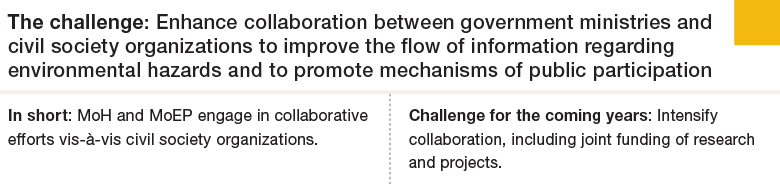

Following an open call for proposals, the Environment and Health Fund (EHF) and MoH are jointly funding the National Biomonitoring Program, including an assessment of children’s exposure to environmental contaminants. (See the “Human Biomonitoring” chapter.) In another collaborative project, EHF and the Israel National Council for the Child are promoting a legislative framework designed to protect infants, toddlers, and children from exposure to chemicals in consumer products. (See the “Chemicals in Consumer Products” chapter.)
There is also collaboration between MoEP and civil society organizations on environmental issues relevant to vulnerable populations. For example, MoEP and the Jewish National Fund (KKL-JNF) launched the “Easy to Breathe” national environmental program in 2017, designed to reduce pollution and environmental hazards and improve air quality in Israel. The program provides NIS 390 million in funding for four green transportation projects, including investment in electric public transport, hybrid vehicles, and installation of particle filters on garbage trucks. It also funds green energy projects (energy efficiency) and planning initiatives (renovating housing and installing solar energy infrastructure).
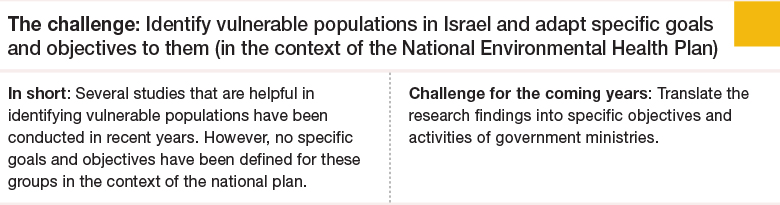
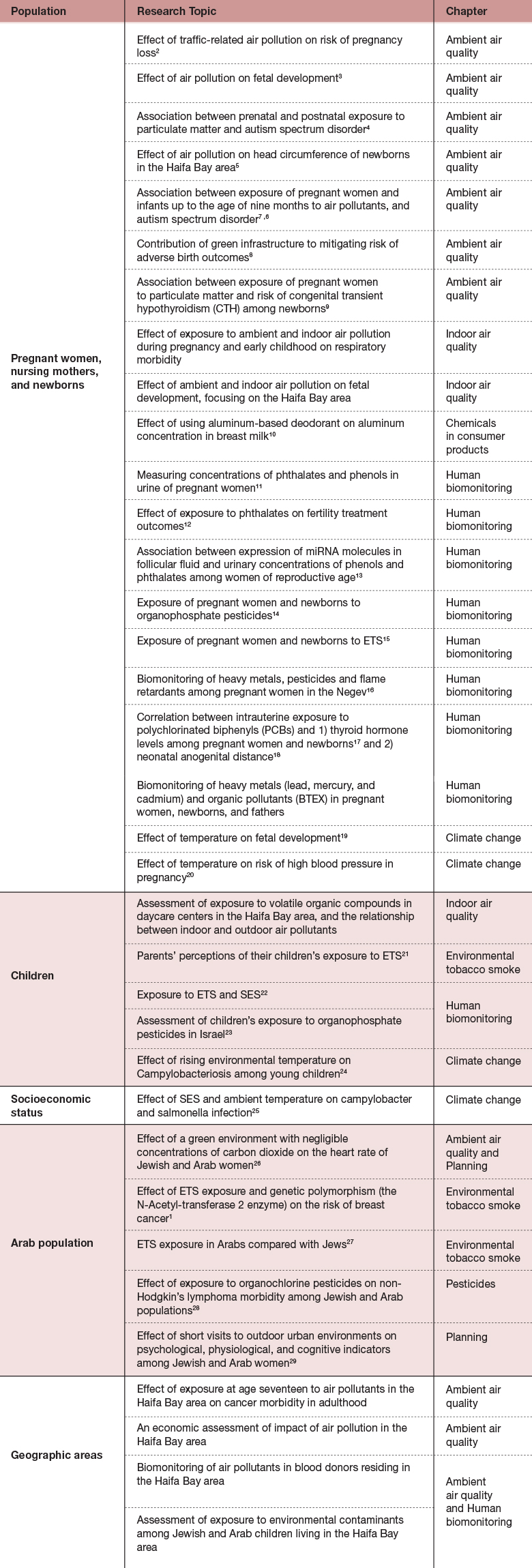
Recent studies in Israel that are helpful in identifying vulnerable populations are presented in Table 1.

There has been little research on genetic variability and vulnerable populations in recent years. Researchers from the University of Haifa examined the association between exposure to environmental tobacco smoke (ETS) and genetic variability (polymorphisms of the N-Acetyl-transferase 2 enzyme), and the risk of breast cancer among Israeli Arab women.1
Research on Vulnerable Populations in Israel
Many environmental health studies address vulnerable populations, focusing mostly on pregnant women and newborns, children, and residents of various geographic areas. Some address other vulnerable populations in Israel, such as the Arab population and low SES groups (Figure 1 and Table 1).
Figure 1: Environmental Health Research Studies on Vulnerable Populations in Israel, by Sub-population, 2017–2020
Source: Israel Ministry of Health
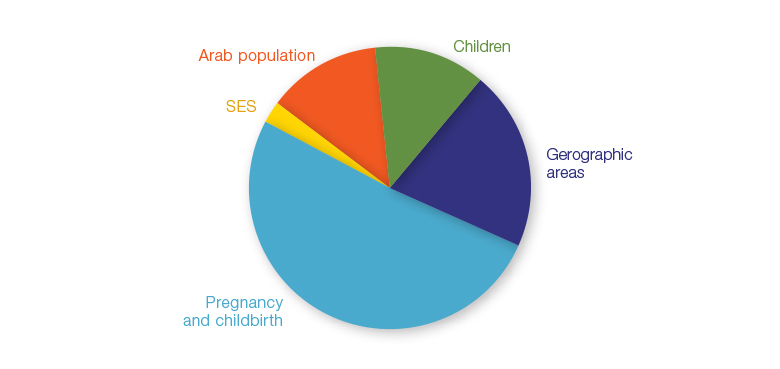
Table 1: Environmental Health Research Studies on Vulnerable Populations in Israel, by Sub-population, 2017–2020
Source: Israel Ministry of Health
Future Challenges
The population in Israel is growing rapidly despite limited land resources, and is expected to increase by 48% between 2035 and 2100.30 Consequently, new residential neighborhoods are being built in locations close to agricultural fields and airfields. The people who move into these neighborhoods are likely to become vulnerable populations in the context of environmental health. Communities living near agricultural fields, for example, may have higher exposure to pesticides sprayed on the ground or from the air, and communities living near airports may face increased exposure to noise and, possibly, to air pollution.
Along with the expected increase in the size of the general population, the elderly population is expected to grow dramatically (by 117%). For this reason and in view of the limited research in Israel on the health impacts of environmental pollution on the elderly, data on the burden of disease from environmental pollution among this population are needed, as are steps to reduce this burden.30
The air monitoring network in Israel has expanded and covers broader geographical areas than in the past. However, there are still some populated areas, especially in the periphery, including Bedouin settlements in southern Israel, that are not regularly monitored. Consideration should be given to expanding the monitoring network to cover these areas.
Other vulnerable populations include the migrant and refugee populations in Israel. These populations are generally characterized by relatively low SES, less access to medical services, and the likelihood of exposure to various environmental contaminants such as ETS. They should be included in plans to promote environmental health and reduce exposure to environmental pollutants.
Consideration should be given to establishing an interdisciplinary inter-ministerial committee to develop a national intervention plan on environmental health among vulnerable populations, on the basis of findings from recent research in Israel and abroad.